Dienstag, 12. Oktober 2021

“Currency conversions are cosmetic measures that have no effect on income, expenses or the macroeconomic environment,” he said. “You are going to gain back the zeros you eliminated


Venezuela Burns Scarce Cash to Prop Up Its Revamped Currency

  •  
    Central bank has intervened since launching digital bolivar
  •  
    Reserves were at a 30-year low in September amid gold sales
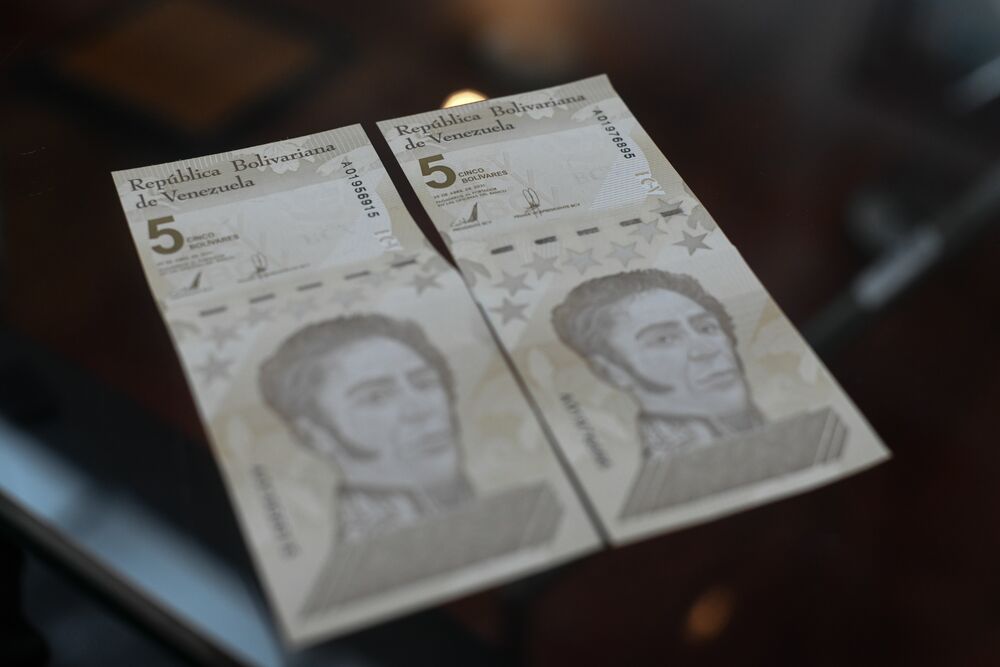
New bolivar banknotes are displayed on a table at a Banesco Banco Universal branch ahead of a currency re-denomination in Caracas, Venezuela, on Oct. 1. 
New bolivar banknotes are displayed on a table at a Banesco Banco Universal branch ahead of a currency re-denomination in Caracas, Venezuela, on Oct. 1.  Photographer: Carolina Cabral/Bloomberg

Venezuela is moving to prop up its national currency after the launch of a new version of the bolivar with six fewer zeros caused prices to spike. 

The central bank has injected around $40 million per week into the exchange market following the Oct. 1 introduction of the so-called digital bolivar. That’s about double the amount it normally sends to banks. 

So far, it’s worked. The exchange rate on the street -- known as the parallel market -- was 4.1 bolivars per dollar Tuesday. The currency had weakened to 5.2 per dollar in advance of the digital bolivar’s introduction as Venezuelans rushed to get their hands on greenbacks. 

Around the capital, Caracas, the roll out of the new currency was accompanied by a sharp price increase. The cost of a basket of eight basic products rose 13.7% the week of the currency’s launch, the second-highest weekly increase of the year, according to political opposition-led Finance Observatory. However, after the central bank’s intervention, the price of the basket returned to pre-conversion levels, said opposition lawmaker Angel Alvarado, a founder of the observatory.  

“The question is whether the central bank has enough cash to support this policy and, therefore, if it’s worth it,” Alvarado said.

As of September, international reserves sat at a 30-year low, as the government sold off gold for much-needed cash. In the past month, the central bank added $5 billion to its reserves level, an amount that corresponds with borrowing rights allocated by the International Monetary Fund. However, Venezuela can’t access the IMF funds because members haven’t agreed on who is the country’s legitimate leader. 

Cash Interventions

Venezuela boosted USD injections ahead of the digital bolivar's launch

Source: Venezuela Central Bank


Venezuelans have struggled with hyperinflation since 2017. Although price increases have decelerated this year, they remain sensitive to the exchange rate volatility. The value of the bolivar had been eroded to a point that accounting systems could no longer support the long figures.

The re-denomination of the currency -- the third one since 2008 -- was intended to make commercial transactions easier. The government introduced a family of new coins and bills, the largest, for 100 bolivars, worth around $24. 

Yet, banks have been mostly supplying the lower denominations of 5 and 10 bolivars. Dollars are still dominating most cash transactions, even in low-income sectors.

Fearing the volatility of the bolivar, Adrian Vegas has kept prices in dollars for goods at her small shop on the outskirts of Petare, a slum in Caracas.

“Imagine having to change prices in bolivars every day,” she said. 
Venezuelan Central Bank Issues New Currency Redenomination
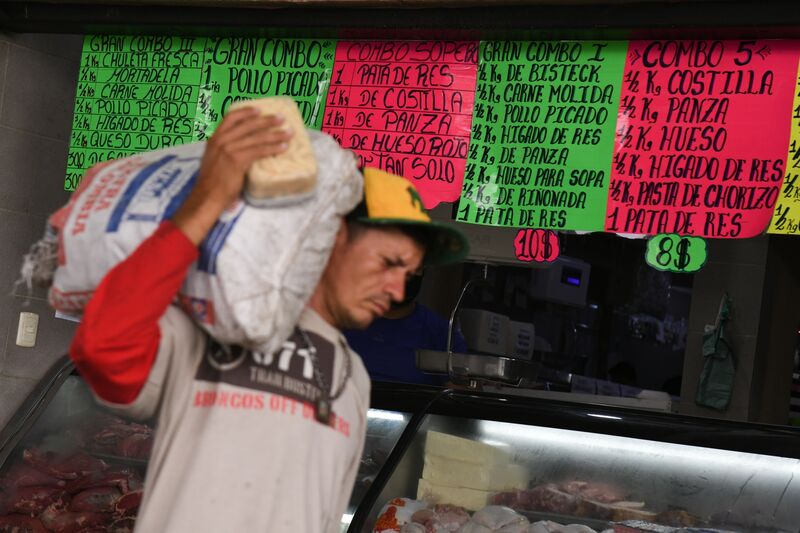
A butcher store lists prices in U.S. dollars in the Petare neighborhood of Caracas, Venezuela, on Monday, Oct. 4, 2021. Venezuela launched a new version of the bolivar in the latest attempt to salvage a currency so beaten down by years of hyperinflation that residents have adopted the U.S. dollar.
Photographer: Carolina Cabral/Bloomberg

President Nicolas Maduro’s administration had already been letting the economy slide into an unofficial dollarization and bolivars are now mostly used to pay for public transportation, subsidized gasoline. 

Read more: Venezuela’s Battered Bolivar Gets Makeover

“People see a price and they don’t even think about the digital bolivar. They think dollars,” said Jose Estrada, manager of a butcher shop. Still, he said this latest currency conversion was “easier,” because before the reconversion even the most basic staples were priced at several million bolivars. 

That may be short-lived, however, unless the government is able to control inflation, said Jose Manuel Puente, an economics professor at the Public Policy Center of the Institute of Higher Education in Management (IESA).

“Currency conversions are cosmetic measures that have no effect on income, expenses or the macroeconomic environment,” he said.  “You are going to gain back the zeros you eliminated

Montag, 11. Oktober 2021

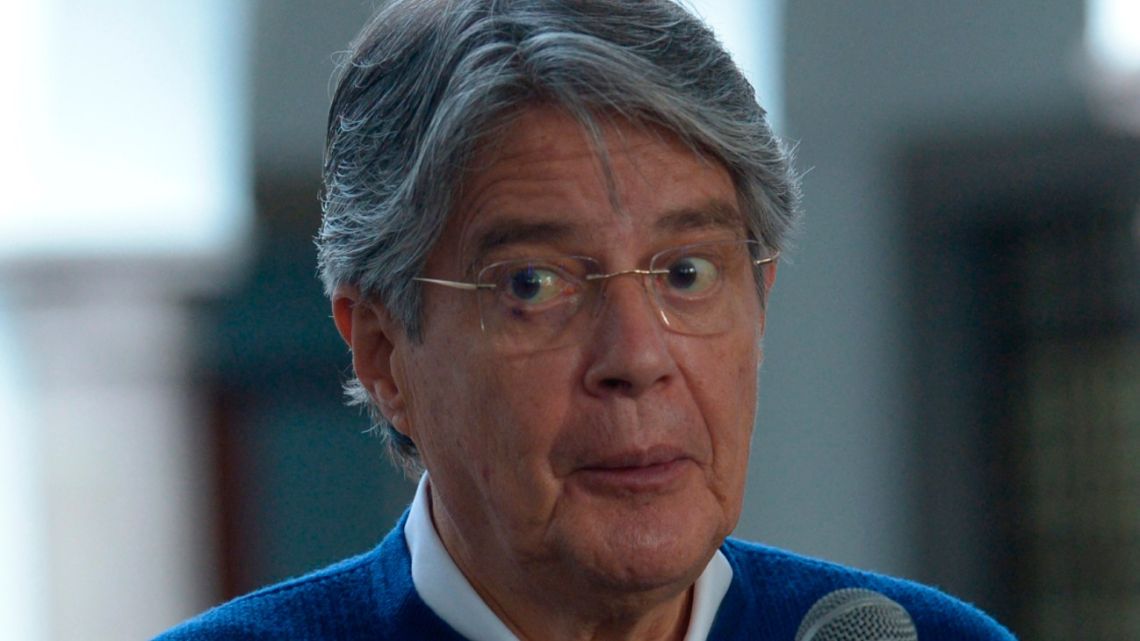
Lasso, who took office in May, has said that years ago he had "legitimate investments in other countries" and that he got rid of them to compete in the presidential election.


Ecuador's legislature to investigate president over Pandora Papers

Ecuador's legislature votes to open investigation into whether Guillermo Lasso broke the law by keeping assets in tax havens.

Ecuador's legislature on Sunday voted to open an investigation into whether President Guillermo Lasso broke the law by keeping assets in tax havens, after the Pandora Papers leaks.

WERBUNG

Lasso, Ecuador's first right-wing president in 14 years, is among scores of politicians, businessmen and celebrities who appear in the Pandora Papers, an investigation by an international consortium of journalists that exposed secret offshore accounts.

The probe of Lasso's activity will be conducted by the country's Constitutional Commission within 30 days, the legislature said in a statement.

The investigation is meant to determine whether the 65-year-old president "may have breached" the norm that "prohibits candidates and public officials from having their resources or assets in tax havens," the legislature said.

According to the Pandora Papers, Lasso controlled 14 offshore companies, most of them based in Panama, and closed them after the passage of a law in 2017 that prohibited presidential candidates from having companies in tax havens.

Lasso, who took office in May, has said that years ago he had "legitimate investments in other countries" and that he got rid of them to compete in the presidential election.

– AFP

Vice President Delcy Rodríguez announced last monday on a state television broadcast that the Colombian-Venezuelan border will reopen for commercial exchange.


Venezuela

Last week, Venezuelan Vice President Delcy Rodríguez said that her country has not yet received funding from an International Monetary Funds (IMF) program meant to help countries combat COVID-19 due to disputes about the government's legitimacy, Reuters reported. The U.S. is the IMF's largest shareholder, and it has sanctioned Venezuelan institutions in an effort to get rid of President Nicolás Maduro. The IMF had previously granted Venezuela $5bn in funding as part of its $650bn global effort to help poorer countries fight back against the coronavirus pandemic. However, Venezuela has been prevented from using the funds over questions about who is Venezuela's rightful leader. 

Also last week, in the framework of the reopening of the border between Colombia and Venezuela, the President of the Republic, Nicolás Maduro, reiterated last Thursday his willingness to re-establish commercial exchange with Colombian businessmen. After inviting Colombian entrepreneurs into investing in the country, Maduro mentioned several businessmen called him mentioning their interest into investing in the country. Duque, Colombian president, also opened the door on starting talks with Venezuela to re-open consular services as well as to open a commercial line with their neighbor country. Vice President Delcy Rodríguez announced last monday on a state television broadcast that the Colombian-Venezuelan border will reopen for commercial exchange.


Credit

Type / ISIN

Indicative price (%)*

Venezuela

VENZ 13 5/8 08/15/18

10.5

11

Venezuela

VENZ 9 ¼ 09/15/27

10.5

11

Venezuela

VENZ 7 3/4 10/13/19

10

11

Venezuela

VENZ 6 12/09/20

10

11

Venezuela

VENZ 12 3/4 08/23/22

10.5

11

Venezuela

VENZ 9 05/07/23

10

11

Venezuela

VENZ 8 1/4 10/13/24

10

11

Venezuela

VENZ 7.65 04/21/25

10

11

Venezuela

VENZ 11 3/4 10/21/26

10.5

11

Venezuela

VENZ 9 1/4 05/07/28

10

11

Venezuela

VENZ 11.95 08/05/31

10.5

11

Venezuela

VENZ 9 3/8 01/13/34

10

11

Venezuela

VENZ 7 03/31/38

10

11

Venezuela

ICSID Claims

Call desk for Prices

PDVSA

PDVSA 8 1/2 10/27/20

25

28

PDVSA

PDVSA 9 11/17/21

5.5

6.5

PDVSA

PDVSA 12 3/4 02/17/22

5.5

6.5

PDVSA

PDVSA 6 10/28/22

3.0

4.5

PDVSA

PDVSA 6 05/16/24

5.5

6.5

PDVSA

PDVSA 6 11/15/26

5.5

6.5

PDVSA

PDVSA 5 3/8 04/12/27

5.5

6.5

PDVSA

PDVSA 9 3/4 05/17/35

5.5

6.5

PDVSA

PDVSA 5 1/2 04/12/37

5.5

6.5

PDVSA

Promissory Notes

Call desk for Prices

PDVSA

Trade Receivables

Call desk for Prices

* Indicative price for positions with institutional size only. For smaller sizes please call desk


Argentina

In Washington, Guzmán plans to participate next Tuesday in the meeting of finance ministers and central bank heads of the Group of Twenty. He will attend the annual meeting of the International Monetary Fund and the World Bank, which will be held between Monday and Saturday.

The Argentine minister also has other activities on the agenda, including meetings with investors in New York, but one of the The focal points of his trip to the United States will be to continue talks with the International Monetary Fund. Argentina intends to reach an agreement on the extended facility with the International Monetary Fund, with lower interest rates and repayment terms for at least 10 years.s, to refinance the debt contracted with the Agency from the Financial Assistance Agreement concluded in 2018, during the government of Mauricio Macri (2015-2019).


Credit

Type / ISIN

Indicative price (%)*

Argentina

ARGENT 0 1/2 07/09/30

36.8

38.1

Argentina

ARGENT 1 07/09/29

38.2

39.5

Argentina

ARGENT 1 1/8 07/09/35

32.8

33.5

Argentina

ARGENT 2 1/2 07/09/41

36.7

37

Argentina

ARGENT 2 01/09/38

38.9

39.4

Argentina

ARGENT 1 1/8 07/09/46

33.3

34.1

Province of Buenos Aires

BUENOS 3.9 09/01/37

46.4

48.9

Province of Buenos Aires

BUENOS 2.85 09/01/37

39.4

42.3

Province of Buenos Aires

BUENOS 3 1/2 09/01/37

40.3

41.4

Province of Buenos Aires

BUENOS 3 09/01/37

35.5

38.1

Province of Buenos Aires

BUENOS 2 09/01/37

33.5

34

Province of Buenos Aires

BUENOS 2 1/2 09/01/37

34.6

35.4

YPF

YPFDAR 8 1/2 07/28/25

82.3

83.5

YPF

YPFDAR 8 3/4 04/04/24

90

91.9

YPF

YPFDAR 6.95 07/21/27

72.5

75.2

YPF

YPFDAR 7 12/15/47

65.5

67

YPF

YPFDAR 8 1/2 06/27/29

76.8

80.9

Banco Macro

BMAAR 6 3/4 11/04/26

85.2

88.9

* Indicative price for positions with institutional size only. For smaller sizes please call des

Mittwoch, 6. Oktober 2021

CARPEVIGO AG – Anleihen sind aufgrund nichtiger Beschlüsse seit 1. Juli 2016 fällig 28.02.2019 3 Minuten Lesezeit (2) Hintergrund der Nichtigkeitsfeststellungklagen


CARPEVIGO AG – Anleihen sind aufgrund nichtiger Beschlüsse seit 1. Juli 2016 fällig

  • 3 Minuten Lesezeit
  • (2)

Hintergrund der Nichtigkeitsfeststellungklagen

Die Carpevigo AG hatte bereits im Jahr 2007 Anleihen in zwei Tranchen emittiert. Die 2. Tranche hatte einen Nominalwert von 15 Millionen Euro und eine Endfälligkeit bis 9. Juli 2013. Am 18. Juli 2013 wurde die Endfälligkeit auf den 30. Juni 2016 verschoben und Herr Rechtsanwalt Franz Wagner zum gemeinsamen Vertreter bestellt. Mit der Bevollmächtigung des gemeinsamen Vertreters zur Begleitung der Sanierung im Jahr 2013 war zugleich beschlossen worden, dass „der einzelne Anleihegläubiger zur selbständigen Geltendmachung dieser Rechte nicht mehr befugt“ sei.

Umfang und Inhalt dieser „Entrechtung“ der Anleihegläubiger war und ist Gegenstand zahlreicher Gerichtsverfahren.

Kurz vor Ablauf der verlängerten Laufzeit wurde ein weiteres Mal zur Versammlung der Anleihegläubiger eingeladen. Wieder sollte die Laufzeit der Anleihe verschoben werden. Beabsichtigt war, dass der gewählte gemeinsame Vertreter allein hierzu abstimmen sollte. Die Anleihegläubiger sollten aufgrund der Übertragung ihrer Befugnisse nicht selbst abstimmen können. Der Widerstand der Anleihegläubiger auf der Versammlung war so groß, dass der gemeinsame Vertreter nicht abstimmte. Es wurde zu einer sog. Zweiten Versammlung geladen. Diesmal wurde über jeden Tagesordnungspunkt zweimal abgestimmt: Einmal stimmte der gemeinsame Vertreter ab, und einmal stimmten die Anleihegläubiger ab. Es wurde beschlossen, dass der Zins der Anleihe sinken sollte und die Laufzeit der Anleihe sollte bis 30. Juni 2021 verlängert werden. Die Beschlüsse dieser Versammlung waren Gegenstand des Rechtsstreits 1 HK 3131/16 des Landgerichts München II. 

Zum Umfang der Befugnisse des gemeinsamen Vertreters

Erstaunlich in diesem Kontext war, dass sich das Gericht zu der Frage erklären musste, ob die Anfechtungsklage überhaupt von den Anleihegläubigern geführt werden durfte, oder aber der gemeinsame Vertreter hierzu allein berechtigt gewesen sein soll. Zutreffend hat das Gericht festgestellt, dass im Zweifel nicht anzunehmen sei, dass sich die Anleihegläubiger hätten praktisch vollkommen rechtlos stellen wollten. Mit Urteil vom 25. Oktober 2018 sind die Beschlüsse für nichtig erklärt worden.

Dieses Ergebnis hatte die Emittentin antizipiert, und aus diesem Grund hatte die Emittentin bereits am 20. November 2017 ein weiteres Mal zur Gläubigerversammlung eingeladen. Es sollten die bisher gefassten Beschlüsse bestätigt werden bzw. die Fehler sollten behoben werden. Diesmal durften die Anleihegläubiger selbst abstimmen.

Besonderheit war, dass bei der Abstimmung der Versammlungsleiter 1.820 Stimmen von Anleihegläubigern nicht zählten, da diese gegen die Bestätigung abgestimmt hatten. Begründet wurde dies erst in der Anfechtungsklage damit, dass es sich um „räuberische Anleihegläubiger“ gehandelt habe. Mit den verbleibenden Stimmen erreichte die Versammlung die vermeintliche Mehrheit.

Bestätigungsbeschlüsse sind ebenfalls nichtig

Nunmehr hat auch die zweite Kammer des Landgerichts München II diese Beschlüsse für nichtig erklärt. Auch hier hatte das Gericht darüber zu entscheiden, ob der gemeinsame Vertreter allein berechtigt gewesen sein soll, die Beschlüsse anzufechten. Zutreffend folgte auch hier das Gericht der Auffassung, dass im Zweifel nicht anzunehmen sei, dass sich die Anleihegläubiger praktisch vollkommen rechtlos stellen wollten.

Rechtsanwältin Dr. Schmidt-Morsbach meint hierzu: „Die Anleihegläubiger sollten nach Auffassung der Emittentin in der Anleihegläubigerversammlung nicht selber abstimmen können. Dieser völlig abwegigen Rechtsmeinung setzte die Carpevigo AG in der Verteidigung gegen die Anfechtungsklagen die Krone auf. Die Anleihegläubiger sollten diese Beschlüsse auch nicht anfechten dürfen. Mit den vorliegenden Urteilen kann ein vorläufiger Schlussstrich unter dieses absurde Theater gezogen werden.“

Beide Entscheidungen sind nicht rechtskräftig. Fraglich ist, wie es nun weitergehen soll. 

Anleihen der Carpevigo AG sind seit dem 1. Juli 2016 fällig!

Mit den nichtigen Beschlüssen sind die Anleihen somit seit dem 1. Juli 2016 fällig und mit 9 % zu verzinsen. Eigentlich ein Grund sofort zu klagen und auf Zahlung zu bestehen. Diesen Anspruch haben auch Anleihegläubiger bereits gerichtlich verfolgt. Das Gericht hat aber erstinstanzlich festgestellt, dass die Anleihegläubiger aufgrund der „umfassenden Bevollmächtigung des gemeinsamen Vertreters“ nicht zur Geltendmachung dieser Forderung berechtigt seien.

Rechtsanwältin Dr. Schmidt-Morsbach meint hierzu: „Die Auffassung des Gerichts ist unseres Erachtens nicht haltbar. Eine Auslegung des Beschlusses ergibt keine derartig weitreichende Ermächtigung. Dies würde die Anleihegläubiger faktisch rechtlos stellen. Kein Anleihegläubiger der Carpevigo AG wollte bereits im Jahr 2013 darauf verzichten, seine später fällig werdenden Ansprüche auf Rückzahlung der Anleihe gerichtlich durchzusetzen. Wir werden dieses Urteil nicht rechtskräftig werden lassen. Wir sind sehr zuversichtlich, dass die aus unserer Sicht zwingende Auslegung bestätigt werden wird.“

Für ergänzende Fragen wenden Sie sich gerne an uns!

senegal

  Markets IMF Draws Packed Senegal Session as New Program Talks Drag By  Vinicius Andrade  and  Jorgelina Do Rosario April 20, 2026 at 5:01 ...