Dienstag, 17. Mai 2022

US to ease a few economic sanctions against Venezuela The United States government is moving to ease a few economic sanctions on Venezuela in a gesture meant to encourage resumed negotiations between the U.S.-backed opposition and the government of President Nicolás Maduro


US to ease a few economic sanctions against Venezuela

The United States government is moving to ease a few economic sanctions on Venezuela in a gesture meant to encourage resumed negotiations between the U.S.-backed opposition and the government of President Nicolás Maduro

The limited changes will allow Chevron Corp. to negotiate its license with the state-owned oil company, PDVSA, but not to drill or export any petroleum of Venezuelan origin, two senior U.S. government officials told The Associated Press late Monday. The officials spoke under the condition of anonymity because the formal announcement had not been made.

Additionally, Carlos Erik Malpica-Flores — a former high-ranking PDVSA official and nephew of Venezuela’s first lady — will be removed from a list of sanctioned individuals, they said.

The moves follow goodwill gestures by Maduro after meeting in March with representatives of the administration of President Joe Biden and a recent gathering in Central America between U.S. officials and the main Unitary Platform opposition coalition to discuss a path forward.

“These are things that ... the Unitary Platform negotiated and came to us to request that we do in order for them to be able to return to the negotiating table,” one of the officials said.

Scores of Venezuelans, including the country's attorney general and the head of the penitentiary system, and more than 140 entities, among them Venezuela's Central Bank, will remain sanctioned. The Treasury Department will continue to prohibit transactions with the Venezuelan government and PDVSA within U.S. financial markets.

Maduro himself is under indictment in the United States, accused of conspiring “to flood the United States with cocaine” and use the drug trade as a “weapon against America.”

Venezuela's government suspended talks with the opposition in October after the extradition to the U.S. of a key Maduro ally on money laundering charges. Maduro at the time conditioned his return to the negotiating table on the release from custody of businessman Alex Saab, who was extradited from the African nation of Cape Verde.

The negotiations took place in Mexico City under the guidance of Norwegian diplomats. The opposition and the Venezuelan government on Tuesday were expected to announce the resumption of negotiations.

California-based Chevron is the last major U.S. oil company to do business in Venezuela, where it first invested in the 1920s. Its four joint ventures with PDVSA produced about 200,000 barrels a day in 2019, but the U.S. government ordered it in 2020 to wind down production, and since then, it has only been allowed to carry out essential work on oil wells to preserve its assets and employment levels in Venezuela.

The change allows “Chevron to negotiate the terms of the potential future activities in Venezuela,” a senior U.S. official told reporters Tuesday. "It does not allow entry into any agreement with PDVSA or any other activity involving PDVSA or ... Venezuela's oil sector. So, fundamentally, what they are doing is just allowed to talk.”

Chevron did not immediately respond to a request for comment Tuesday. The company's investments in Venezuela's oil fields and machinery over the last century had an estimated value of $2.6 billion as of 2020.

Venezuela sits atop the world’s largest oil reserves, yet its political upheaval and economic decline have pushed more than 6 million people to migrate in recent years. About three quarters of those who remain live on less than $1.90 a day, considered the international standard for extreme poverty, and many lack access to clean, running water and electricity.

The U.S. and other countries withdrew recognition of Maduro after accusing him of rigging his 2018 reelection as president. In his place, they recognized Juan Guaidó, who was head of the then-opposition-dominated congress and remains the leader of the Unitary Platform.

For the past five years, the U.S. has used punishing financial and personal sanctions, criminal indictments and support for clandestine groups in an unsuccessful campaign to remove Maduro and restore what it sees as Venezuela’s stolen democracy.

But in March, U.S. officials traveled to Venezuela’s capital, Caracas, to meet with Maduro after Russia’s invasion of Ukraine upended the world order and forced Washington to rethink its national security priorities.

After the meeting, Maduro freed two American prisoners and promised to resume negotiations with his opponents.

The senior U.S. officials said the government will calibrate sanctions based on concrete outcomes at the negotiations and would reimpose them in the event of backsliding in the dialogue process.

“What you are seeing here is a very honed approach that is looking at a clear roadmap in Venezuela, where the only path that the regime has toward the alleviation of sanctions from the United States is a negotiation that leads to concrete outcomes,” one of the officials told reporters.

Malpica-Flores was once national treasurer and PDVSA's vice president of finance. He was individually sanctioned in 2017 as the U.S. targeted people associated with Venezuela's rampant government corruption.

His aunt, Cilia Flores, is one of the most influential members of Venezuela’s government and a constant presence alongside her husband. Two other nephews of hers are imprisoned in the U.S. on drug conspiracy convictions.

On Wednesday, 18 Democratic Party senators urged President Joe Biden to continue pursuing dialogue with the Venezuelan government and, in support of that process, to consider lifting the economic sanctions against it. “The U.S. government has already lifted many sanctions against the Maduro regime. This request only seeks to cover what Biden proposes to announce very soon," alleged Rubio, who is widely known for its aggressive policy a


Venezuela

On Wednesday, 18 Democratic Party senators urged President Joe Biden to continue pursuing dialogue with the Venezuelan government and, in support of that process, to consider lifting the economic sanctions against it. “The U.S. government has already lifted many sanctions against the Maduro regime. This request only seeks to cover what Biden proposes to announce very soon," alleged Rubio, who is widely known for its aggressive policy against Cuba and Venezuela.  A  trip to Caracas by a White House delegation in March raised the prospect of sanctions relief to resume supplies of Venezuelan extra-heavy crude to U.S. refineries in an attempt to offset the impact of blocking Russian hydrocarbon imports. U.S. Senator Marco Rubio then sent a letter to President Joe Biden urging him to publicly reaffirm the United States’ existing policy toward Venezuela and invite the interim government to the upcoming Summit of the Americas. 

Also last week, deputy foreign minister, Isadora Zubillaga, has warned that the west must not backslide into aiding the Venezuelan president, Nicolás Maduro, or it will hand victory to an autocratic alliance led by Vladimir Putin and weaken the democratic cause in Europe and Venezuela. The last attempt at talks between supporters of Guaidó and supporters of Maduro, brokered by Norwegian officials, ended in October when the government withdrew after a high-profile Maduro adviser, Alex Saab, was extradited to the U.S. to face charges of alleged money laundering. Zubillaga also indicated the intention of the opposition to return to the negotiating table.

CreditType / ISINIndicative price (%)*
EcobatB SharesCall desk for Prices
VenezuelaVENZ 9 ¼ 09/15/2789
VenezuelaVENZ 7 3/4 10/13/1989
VenezuelaVENZ 6 12/09/2089
VenezuelaVENZ 12 3/4 08/23/2289
VenezuelaVENZ 9 05/07/2389
VenezuelaVENZ 8 1/4 10/13/2489
VenezuelaVENZ 7.65 04/21/2589
VenezuelaVENZ 11 3/4 10/21/2689
VenezuelaVENZ 9 1/4 05/07/2889
VenezuelaVENZ 11.95 08/05/3189
VenezuelaVENZ 9 3/8 01/13/3489
VenezuelaVENZ 7 03/31/3889
VenezuelaICSID ClaimsCall desk for Prices
PDVSAPDVSA 8 1/2 10/27/2015.517.5
PDVSAPDVSA 9 11/17/216.57.5
PDVSAPDVSA 12 3/4 02/17/226.57.5
PDVSAPDVSA 6 10/28/2245
PDVSAPDVSA 6 05/16/246.57.5
PDVSAPDVSA 6 11/15/266.57.5
PDVSAPDVSA 5 3/8 04/12/276.57.5
PDVSAPDVSA 9 3/4 05/17/356.57.5
PDVSAPDVSA 5 1/2 04/12/376.57.5
PDVSAPromissory NotesCall desk for Prices
PDVSATrade ReceivablesCall desk for Prices
* Indicative price for positions with institutional size only. For smaller sizes please call desk

Argentina

In Argentina, thousands took to the streets of Buenos Aires Thursday to protest the country’s soaring living and food costs. They’re demanding the government of President Alberto Fernández improve social aid programs, and have spoken out against Argentina’s repayment of a $44bn debt with the International Monetary Fund, which they say largely burdens the people, France 24 reported.

CreditType / ISINIndicative price (%)*
ArgentinaARGENT 0 1/2 07/09/3029.630.2
ArgentinaARGENT 1 07/09/293131.1
ArgentinaARGENT 1 1/8 07/09/3526.629
ArgentinaARGENT 2 1/2 07/09/4131.732.1
ArgentinaARGENT 2 01/09/3834.635.2
ArgentinaARGENT 1 1/8 07/09/4627.728.2
Province of Buenos AiresBUENOS 3.9 09/01/3735.742.2
Province of Buenos AiresBUENOS 2.85 09/01/3732.837.8
Province of Buenos AiresBUENOS 3 1/2 09/01/3731.537
Province of Buenos AiresBUENOS 3 09/01/3727.433.5
Province of Buenos AiresBUENOS 2 09/01/3725.530.9
Province of Buenos AiresBUENOS 2 1/2 09/01/3726.534.4
IMPSAIMPSA 7 1/2 12/30/25Call desk for Prices
YPFYPFDAR 8 1/2 07/28/2578.479.4
YPFYPFDAR 8 3/4 04/04/2490.492.3
YPFYPFDAR 6.95 07/21/2768.470.8
YPFYPFDAR 7 12/15/4755.859.6
YPFYPFDAR 8 1/2 06/27/2970.974.3
Banco MacroBMAAR 6.643 11/04/2687.188.4
* Indicative price for positions with institutional size only. For smaller sizes please call des

Montag, 16. Mai 2022

US-Parlamentarier fordern von Joe Biden die Aufhebung der Sanktionen gegen Venezuela


US-Parlamentarier fordern von Joe Biden die Aufhebung der Sanktionen gegen Venezuela

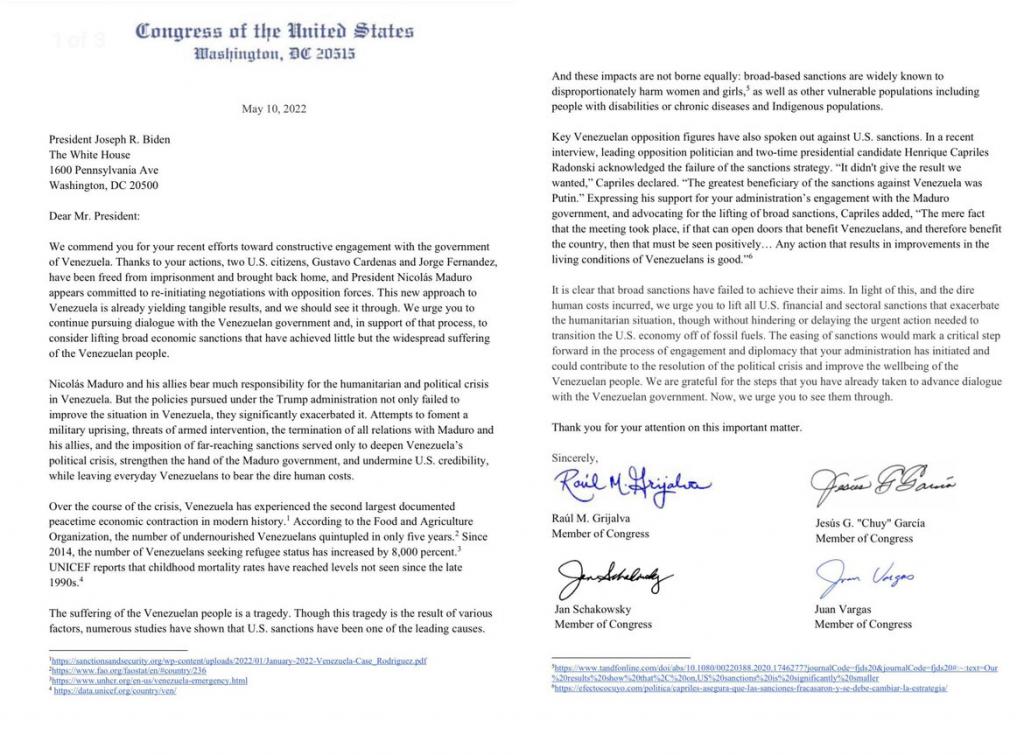
usa_brief_abgeordnete_biden_sanktionen.jpg

"Dear Mr. President": Brief der US-Abgeordneten an Biden vom 10. Mai

Washington. In einem Schreiben an Präsident Joe Biden haben 18 Mitglieder des US-Repräsentantenhauses gefordert, die Sanktionen gegen Venezuela aufzuheben.

Die Abgeordneten der Demokratischen Partei würdigen darin Bidens "jüngste Bemühungen um ein konstruktives Engagement mit der venezolanischen Regierung". Dank seines Einsatzes seien zwei US-Bürger aus venezolanischer Haft befreit worden und Präsident Nicolás Maduro scheine entschlossen, die Verhandlungen mit der Opposition wieder aufzunehmen.

Dieser neue Ansatz gegenüber Venezuela solle weitergeführt werden: "Wir fordern Sie dringend auf, den Dialog mit der venezolanischen Regierung beharrlich fortzusetzen und zur Unterstützung dieses Prozesses die Aufhebung der weitreichenden Wirtschaftssanktionen in Erwägung zu ziehen, die nichts bewirkt haben außer weit verbreitetes Leid in der venezolanischen Bevölkerung."

Zwar trage Maduro große Verantwortung für die Krise im Land, aber die Maßnahmen der US-Regierung unter Donald Trump hätten die Situation in Venezuela nicht nur nicht verbessert, sondern sogar deutlich verschlimmert. "Versuche, einen militärischen Aufstand anzuzetteln, Drohungen mit bewaffneter Intervention, der Abbruch aller Beziehungen zu Maduro und seinen Verbündeten und die Verhängung weitreichender Sanktionen dienten nur dazu, die politische Krise Venezuelas zu vertiefen, die Regierung Maduro zu stärken und die Glaubwürdigkeit der USA zu untergraben, während die einfachen Venezolaner die schrecklichen menschlichen Kosten zu tragen haben".

Das Leiden der venezolanischen Bevölkerung sei eine Tragödie und auch wenn dies "Ergebnis verschiedener Faktoren ist, haben zahlreiche Studien gezeigt, dass die US-Sanktionen eine der Hauptursachen sind", argumentieren die Verfasser des Briefes, den die Abgeordneten Raúl Grijalva and Jesús “Chuy” García initiiert hatten. Auch immer mehr bekannte Oppositionspolitiker des südamerikanischen Landes sprächen sich gegen Sanktionen aus.

"Es ist klar, dass die weitreichenden Sanktionen ihre Ziele nicht erreicht haben. In Anbetracht dessen und der schrecklichen menschlichen Kosten, die damit verbunden sind, fordern wir Sie auf, alle finanziellen und sektoralen Sanktionen der USA aufzuheben", heißt es in dem Dokument weiter.


Freitag, 13. Mai 2022

US-Senatoren fordern Biden auf, die Sanktionen gegen Venezuela aufzuheben Veröffentlicht am 13. Mai 2022 Zu den Kongressabgeordneten, die den Brief an Biden unterzeichnet haben, gehören Alexandria Ocasio-Cortez, Andy Levin, Donald Payne Jr. und Ear Blumenauer.

 US-Senatoren fordern Biden auf, die Sanktionen gegen Venezuela aufzuheben Veröffentlicht am 13. Mai 2022 Zu den Kongressabgeordneten, die den Brief an Biden unterzeichnet haben, gehören Alexandria Ocasio-Cortez, Andy Levin, Donald Payne Jr. und Ear Blumenauer. | Foto: VTV LESEN SIE AUCH: US-Kongressabgeordnete fordern Aufhebung der Maßnahmen gegen Venezuela In dem an die Biden-Administration gerichteten Schreiben werden die negativen Auswirkungen einseitiger Zwangsmaßnahmen in Venezuela anerkannt. Eine Gruppe von 18 demokratischen Senatoren des Kongresses der Vereinigten Staaten (USA) forderte an diesem Donnerstag die Regierung von Präsident Joe Biden auf, die einseitigen Zwangsmaßnahmen gegen Venezuela aufzuheben. Die Anfrage wurde in einem Brief veröffentlicht, der auf dem Konto des Journalisten von Associated Press, Joshua Goodman, auf seinem Konto im sozialen Netzwerk Twitter veröffentlicht wurde. „Präsident Joe Biden, wir loben Sie für Ihre jüngsten Bemühungen um eine konstruktive Zusammenarbeit mit der Regierung Venezuelas. Dank ihrer Aktionen wurden zwei USBürger, Gustavo Cárdenas und Jorge Fernández, aus der Haft entlassen und kehrten mit Ehren zurück, und Präsident Nicolás Maduro scheint fest entschlossen, die Verhandlungen mit den Oppositionskräften wieder aufzunehmen. Weiter betont der Text, dass Venezuelas neuer Ansatz Früchte trägt, so dass die Kongressabgeordneten darauf dringen, den Dialog mit der venezolanischen Regierung fortzusetzen, und dass zur Unterstützung dieses Dialogs die „umfassenden Wirtschaftssanktionen, die nicht mehr bewirkt haben als das weitverbreitete Leid von das venezolanische Volk.“ „Die Versuche, einen Militäraufstand zu schüren, die Androhung einer bewaffneten Intervention, die Beendigung aller Beziehungen zu Maduro und seinen Verbündeten und die Verhängung weitreichender Sanktionen haben nur dazu gedient, die politische Krise in Venezuela zu vertiefen und die Hand zu stärken die Regierung von Maduro und untergräbt die Glaubwürdigkeit der Vereinigten Staaten, während die gewöhnlichen Venezolaner die schrecklichen menschlichen Kosten tragen müssen“, fährt das Dokument fort. Der Text legt die wirtschaftlichen Schwierigkeiten offen, unter denen Venezuela in jüngster Zeit gelitten hat, und zitiert Daten der Ernährungs- und Landwirtschaftsorganisation der Vereinten Nationen (FAO), des Kinderhilfswerks der Vereinten Nationen (UNICEF). In diesem Sinne betonen sie, dass Sanktionen eine der Hauptursachen für diese Tragödien waren. „Angesichts dessen und der entsetzlichen menschlichen Kosten, die entstanden sind, fordern wir Sie dringend auf, alle finanziellen und sektoralen US-Sanktionen aufzuheben, die die humanitäre Situation verschlimmern, ohne die dringenden Maßnahmen zu behindern oder zu verzögern, die für den Übergang der US-Wirtschaft erforderlich sind aus fossilen Brennstoffen“, wiederholten sie. Zu den Unterzeichnern des Briefes gehören die Kongressabgeordneten Alexandria Ocasio-Cortez, Andy Levin, Donald Payne Jr., Ear Blumenauer, James P. McGovern und Ayanna Pressley. Unterdessen antwortete der republikanische Senator des Bundesstaates Florida, Marco Rubio, der für seine aggressive Politik gegenüber Ländern wie Kuba und Venezuela selbst bekannt ist, auf die Veröffentlichung, indem er versicherte, dass die US-Regierung „bereits beschlossen hat, viele Sanktionen gegen die Drogenmafia Maduro aufzuheben. Regime." „Dieser Brief von US-Kongressabgeordneten, die offen marxistisch sind, versucht nur zu vertuschen, was Biden bereits sehr bald ankündigen will“, fügte er hinzu. Stichworte 13.05.22, 15:58 US-Senatoren fordern Biden auf, Sanktionen gegen Venezuela aufzuhebe

Mittwoch, 11. Mai 2022

„Kuba, Nicaragua und das Regime von (Nicolás) Maduro respektieren die demokratische Charta Amerikas nicht, und deshalb erwarte ich ihre Anwesenheit nicht“, kündigte der US-Unterstaatssekretär für Lateinamerika und die Karibik, Brian Nichols, in einem Interview mit dem an Kolumbianischer Sender NTN24 . Im Moment hat Washington noch nicht bestätigt, ob es Guaidó zum Gipfel im nächsten Monat einladen wird, dem zweiten von den Vereinigten Staaten organisierten Gipfel nach der ursprünglichen Ausgabe in Miami im Jahr 1994, dessen Hauptziel darin besteht, einen regionalen Migrationspakt zu entwerfen. (Mit Informationen von EFE


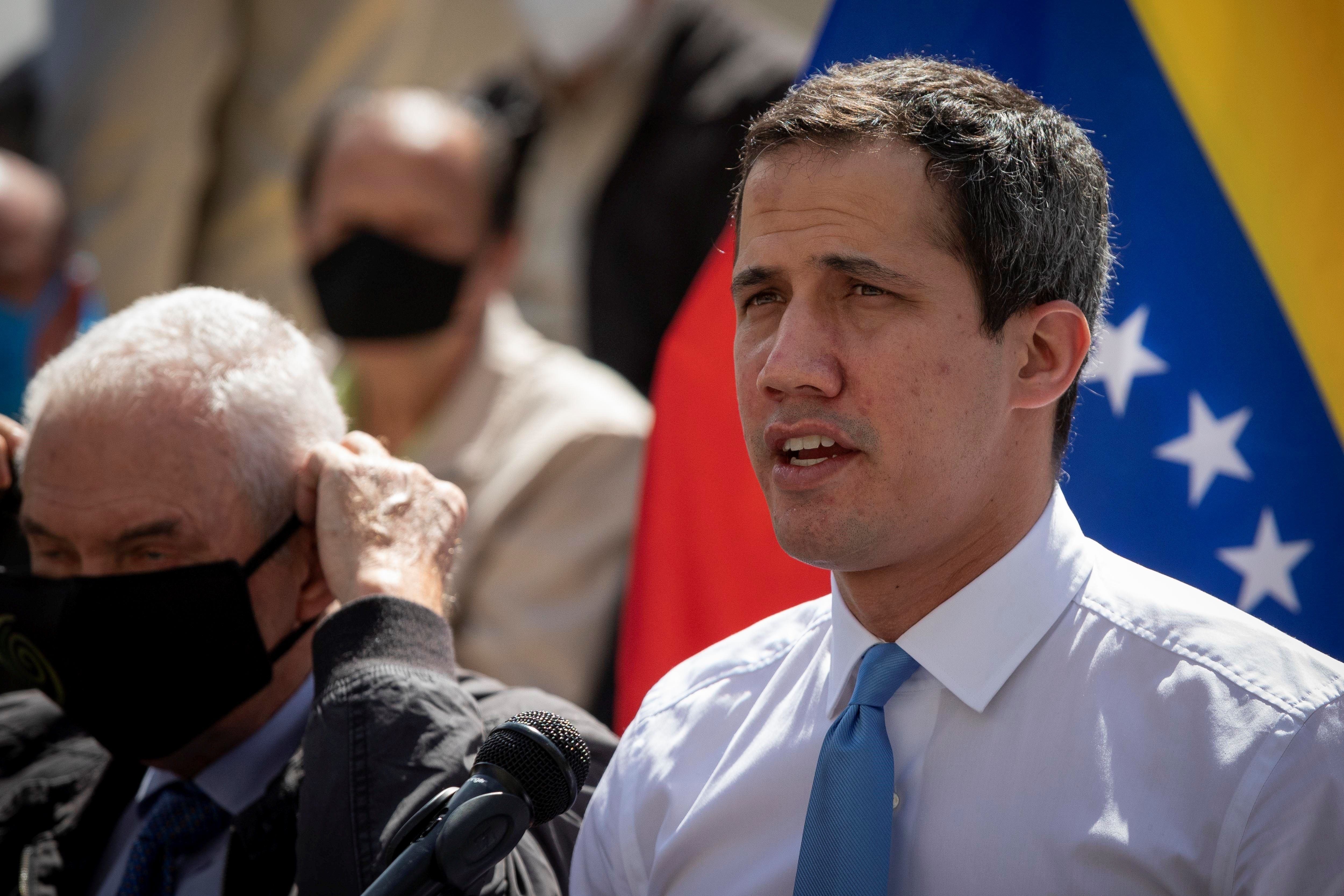
Der venezolanische Oppositionsführer Juan Guaidó spricht heute während einer Pressekonferenz in Caracas (Venezuela).  EFE/RAYNER PEÑA R.
Der venezolanische Oppositionsführer Juan Guaidó spricht heute während einer Pressekonferenz in Caracas (Venezuela). EFE/RAYNER PEÑA R.

Brian A. Nichols, Unterstaatssekretär für Angelegenheiten der westlichen Hemisphäre des US-Außenministeriums, sprach am Mittwoch mit Juan Guaidó und bekräftigte das Engagement des Weißen Hauses als Verbündeter der venezolanischen Opposition im Kampf für Demokratie.

„Ich habe mit Präsident Guiadó gesprochen, um zu wiederholen, dass er und alle Venezolaner, die für Demokratie und Menschenrechte kämpfen , weiterhin einen bedingungslosen Partner und Verbündeten in den Vereinigten Staaten finden werden. Wir bleiben entschlossen, einen ausgehandelten Weg zu unterstützen, der allen Venezolanern zugute kommt“, schrieb Nichols auf seinem Twitter-Account.

An diesem Montag sprach der US-Außenminister Antony Blinken mit Guaidó, dem er wiederholte, dass die Gespräche zwischen dem Regime von Nicolás Maduro und der oppositionellen Unitary Platform „der beste Weg für die Rückkehr zur Demokratie“ in Venezuela seien.

Dies wurde in einer Erklärung des Sprechers des Außenministeriums, Ned Price, angedeutet.

„Sekretärin Blinken bekräftigte das Engagement der USA für die Gespräche zwischen dem Maduro-Regime und der Einheitsplattform als den besten Weg zur Rückkehr zur Demokratie und zur Lösung der humanitären Krise in Venezuela“ , heißt es in der Mitteilung.

Er wies auch darauf hin, dass  Blinken gegenüber Guaidó „die Bedeutung einer friedlichen Wiederherstellung der Demokratie in Venezuela und freier und fairer Wahlen“ betont habe.

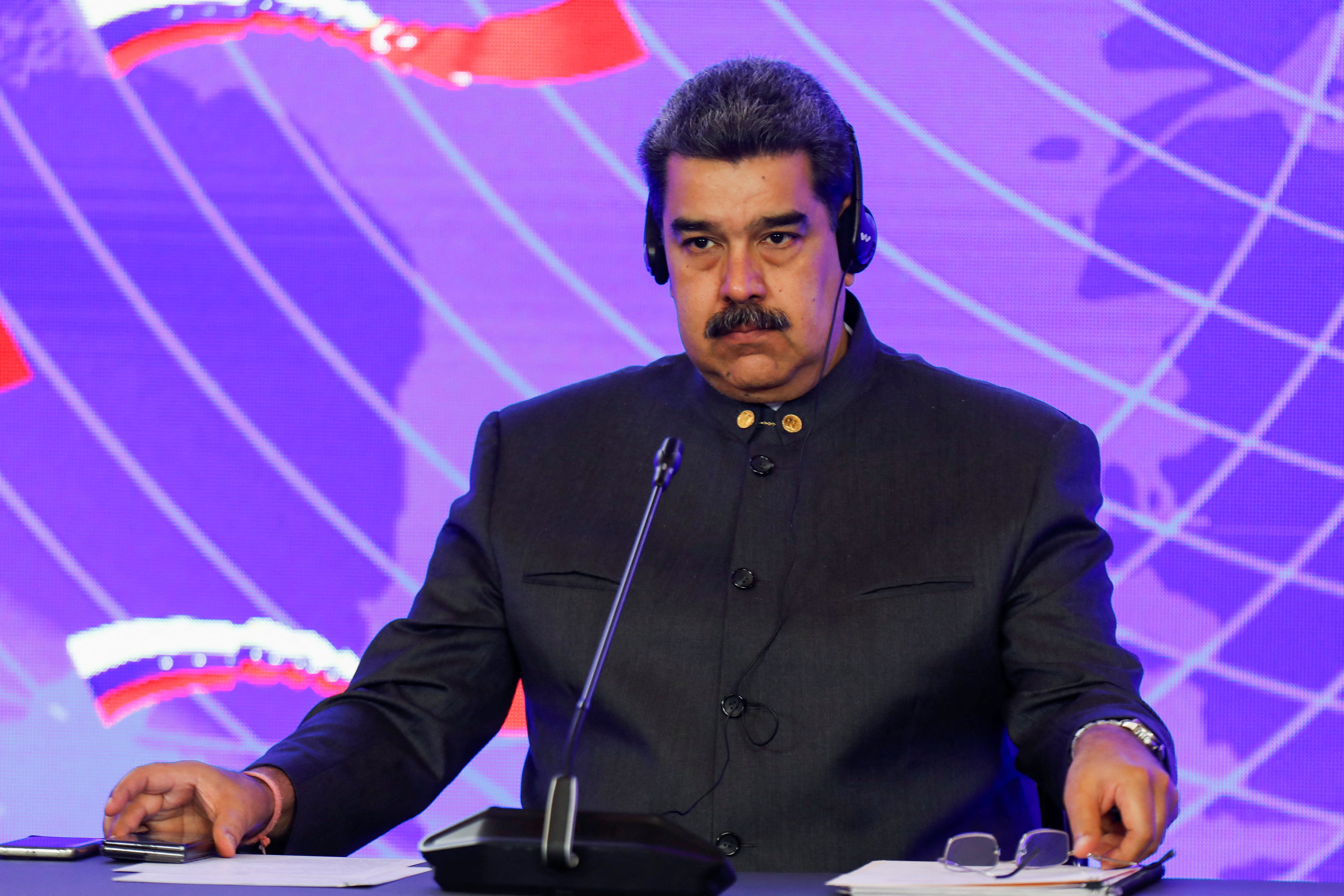
Der venezolanische Diktator Nicolás Maduro.  REUTERS/Leonardo Fernandez Viloria
Der venezolanische Diktator Nicolás Maduro. REUTERS/Leonardo Fernandez Viloria

Das venezolanische Regime und die Opposition einigten sich im August 2021 auf einen Verhandlungstisch in Mexiko, der jedoch im Oktober von der Regierungspartei aus Protest gegen die Auslieferung des kolumbianischen Geschäftsmanns Álex Saab, mutmaßliches Aushängeschild von Maduro, an die Vereinigten Staaten ausgesetzt wurde.

Die USA haben Guaidó zusammen mit etwa 50 Ländern in Lateinamerika und Europa seit 2019 als Interimspräsident Venezuelas anerkannt .

Blinkens Anruf kam am selben Tag, an dem Washington die Einladung der Regierungen Kubas, Nicaraguas und Venezuelas zum Amerika-Gipfel im Juni in Los Angeles (Kalifornien) ausschloss, weil es der Ansicht ist, dass sie die Demokratie „nicht respektieren“. . . .

„Kuba, Nicaragua und das Regime von (Nicolás) Maduro respektieren die demokratische Charta Amerikas nicht, und deshalb erwarte ich ihre Anwesenheit nicht“,  kündigte der US-Unterstaatssekretär für Lateinamerika und die Karibik, Brian Nichols, in einem Interview mit dem an Kolumbianischer Sender  NTN24 .

Im Moment hat Washington noch nicht bestätigt, ob es Guaidó zum Gipfel im nächsten Monat einladen wird, dem zweiten von den Vereinigten Staaten organisierten Gipfel nach der ursprünglichen Ausgabe in Miami im Jahr 1994, dessen Hauptziel darin besteht, einen regionalen Migrationspakt zu entwerfen.

(Mit Informationen von EFE

Montag, 9. Mai 2022

As part of the Florida-based campaign, Governor Ron DeSantis spoke at a rally against buying Venezuelan oil—the supposed purpose of the talks with Maduro.


Biden vacillates as Venezuela’s Maduro gains ground

In the wake of the ‘new Cold War,’ Caracas’ strategic alliance with Moscow has become a greater priority for Washington

USA POLITICSLATIN AMERICA AND THE CARIBBEAN

Venezuelan President Nicolás Maduro’s repeated calls for dialogue with the United States in order to normalize relations seem to be paying off.

His openness to rapprochement contrasts with the Biden administration’s nebulousness regarding the degree to which Washington is willing to recognize Maduro as president (full diplomatic recognition is out of the question).

Biden’s use of sanctions as a bargaining chip to wrest concessions from Caracas is a harder sell than former President Donald Trump’s regime change narrative on the basis of the preposterous Responsibility to Protect (R2P) principle, sometimes referred to as “humanitarian intervention.”

Over the last two months, the flip flops and timidity of the Biden administration have been put on full display.

In early March, Biden sent a high-level delegation to Caracas to talk to Maduro, but then just days later backed off in light of the backlash led by Florida’s congressional bloc headed by Sens. Marco Rubio and Rick Scott and seconded by Sen. Bob Menendez.

Biden spokeswoman Jen Psaki told journalists not to waste their time speculating “about the future of the United States importing oil at this point in time… from Venezuela.”

More recently, The Economist reported that the Biden administration is planning to reengage Maduro’s representatives in a meeting in Trinidad. Shortly thereafter, however, US Assistant Secretary of State Brian Nichols denied the report and claimed that the only issue under discussion in the March meeting in Caracas was related to Venezuelan democracy. The remark contradicts a previous White House statement that the March meeting discussed “global energy security.”

For many centrists, the Biden administration’s ruling out of the military threats and actions employed by Trump appears to be benign and a step in the right direction.

That appearance is enhanced by the belligerent attacks on Biden by the Florida congressional bloc for his use of “sanctions placed on the Maduro regime as a bargaining chip with an illegitimate dictatorship to produce more oil.” Their statement decries Washington’s engagement with Maduro for representing a tacit recognition of his government and undermining the legitimacy of Venezuela’s bogus president, Juan Guaidó.

As part of the Florida-based campaign, Governor Ron DeSantis spoke at a rally against buying Venezuelan oil—the supposed purpose of the talks with Maduro.

Biden’s unwillingness (or inability) to boldly explain and defend his change of policy to US voters also contrasts with former President Barack Obama, who put his cards on the table when he reestablished diplomatic relations with Cuba.

Indeed, it’s hard to know exactly what Biden has in mind as to how to proceed, assuming he himself knows. Brian Winter, Vice President of the Council of the Americas, was right in saying at the time of the first delegation to Venezuela that “until we know precisely what the Biden administration is trying to achieve, it’ll be difficult to evaluate how far this détente can go.”

Ripple effect

Biden’s overtures have worked to Maduro’s advantage, even with, of all places, Brazil.

In late April, Brazil’s Foreign Minister Carlos França stated:

At a moment in which the United States considers making an exception to the embargo on Venezuelan oil exports, it seems to me that we can think in terms of reevaluating the issue of diplomatic relations.


Exactly two years before, Bolsonaro had closed Brazil’s embassy in Venezuela.

Following suit on April 29, Mexico’s President Andrés Manuel López Obrador called Biden to discuss the Ninth Summit of the Americas to be held in Los Angeles in early June. He urged Biden for “all the countries of the Americas [to] receive an invitation, without excluding anyone.”

Shortly before López Obrador made the call, the State Department’s Brian Nichols had addressed reporters on the upcoming summit stating, in reference to Venezuela, Cuba and Nicaragua, “they are unlikely to be there.”

The ripple effect of Washington’s diplomatic mission to Venezuela also reached Ecuador’s conservative President Guillermo Lasso.

In a joint press conference with Argentina’s President Alberto Fernández, Lasso said that his government welcomed the rapprochement between the US and Venezuela and would consider reestablishing diplomatic relations with the latter.

Fernández, for his part, defended his government’s decision to reestablish full relations with Venezuela and called on other countries in the region to do the same, noting “Venezuela has had a difficult time.”

This groundswell in opposition to Venezuela’s ostracization is going to be hard for Washington to contain, especially in light of left and center-left electoral victories since 2018 in Mexico, Argentina, Bolivia and, more recently, Chile and Honduras. Progressive candidates are slated to win in upcoming presidential elections in Colombia and Brazil.

“Hands off Venezuela” demonstration in Philadelphia, February 23, 2019. Photo by Joe Piete/Flickr.

It’s not just the oil

The mainstream media attributed the Biden administration’s abrupt abandonment of its Venezuelan initiative to the backlash from Rubio and company. They were half right.

After all, the State Department had to have anticipated the political consequences when they sent the delegation to Venezuela apparently to negotiate the resumption of oil flows to compensate for shortages resulting from the US sanctions against Russia oil imports.

The Biden administration may have balked, not because of the predictable outcry from Rubio and company, but because Washington didn’t get what it wanted. After all, the delegation’s objective was not just about oil. That’s what the BBC concluded: “So, could the US visit be more than just oil? An attempt to change Venezuela’s political allegiances, perhaps?”

In the words of the Financial Times on March 9, it was to “coax Maduro away from Moscow’s embrace” and assume a more neutral stand on the Ukraine invasion.

Congressman Gregory Meeks, chair of the House Foreign Affairs Committee, said the same when he stated “re-engagement with Venezuela… serves to shift Venezuela away from the malign influence of Vladimir Putin.”

The problem is that Maduro, who has leaned over backwards to assure Washington that he has become investment-friendly toward big oil, refused to turn his back on President Putin. Thus, Venezuela recognized the independence of eastern Ukraine’s two separatist republics just hours after Putin did.

Immediately after the US mission left Caracas in March, Maduro gave Washington a glimmer of hope when he called for dialogue between Moscow and Ukraine, but then reiterated his unconditional support for Moscow.

There is an ideological component to Maduro’s position on Ukraine. The US, according to him, wants to “destroy it [Russia] in pieces and end the hope of a multi-polar world where we can all live.”

Now that the ‘new Cold War’ has set in, geopolitical considerations become a greater priority for US foreign policy.

As professor John Mearsheimer, a leading strategist belonging to the school of realism of international relations, has pointed out, maintaining a secure hemisphere is of greater concern than conflicts elsewhere in the world since it provides the US with an advantage over adversaries located in regions characterized by strife.

The same thesis predicts that other great powers (read China and Russia) will attempt to challenge “regional hegemony,” in the US’s “neighborhood.” Caracas’ strategic alliance with Moscow, which includes Russia’s deployment of warships in Venezuelan ports, takes on a special significance within the framework of Mearsheimer’s line of thinking.

Biden’s bargaining-chip strategy toward Venezuela of lifting some of Washington’s estimated 502 coercive measures in return for concessions is designed to achieve two sets of objectives: providing the United States with much-needed oil and influencing Maduro’s foreign policy.

Juan Gonzalez, the hard-liner who headed the delegation to Venezuela in March, clearly indicated that the use of sanctions goes far beyond their stated purpose:

The sanctions on Russia are so robust that they will have an impact on those governments that have economic affiliations with Russia, that is by design.


Bloomberg News spelled out the “soft-power” strategy employed by the Biden administration in an editorial headlined “Approaching Venezuela is Worth the Risk.” The horse-trading proposal would consist of the following:

In exchange for Venezuela suspending its military cooperation with Russia, the Biden Administration should lift some sanctions against Caracas to allow the country to import equipment to upgrade production facilities and resume oil sales to the United States.


Bloomberg went on to call for tough bargaining: “Any further steps toward normalization should be conditioned on Venezuela’s willingness to accelerate market-oriented economic reforms” at the same time that Washington would continue to recognize Guaidó.

Bloomberg then summarized its approach:

Unpalatable as it may be, engaging with the Venezuelan regime is critical to protecting core US interests and containing Russian influence in the Western Hemisphere.


Biden’s horse-trading strategy has much in common with Trump’s threats and actions in favour of regime change through military force. In both cases, the will of Venezuelans is ignored as is their suffering. What makes the current situation even more despicable is that the bargaining chips were formerly designed to get Venezuela to revise economic policy and now there is an added objective, namely a change in foreign policy.

Pro-Biden centrists who see his approach to Venezuela as more “humanitarian” fail to consider how far removed the Venezuelan people are from Washington’s calculations and political maneuvers.

Steve Ellner, a retired professor of the Universidad de Oriente in Venezuela, is currently Associate Managing Editor of Latin American Perspectives. He is co-editor of Latin American Social Movements and Progressive Governments: Creative Tensions between Resistance and Convergence (Rowman & Littlefield, 2023)

senegal

  Markets IMF Draws Packed Senegal Session as New Program Talks Drag By  Vinicius Andrade  and  Jorgelina Do Rosario April 20, 2026 at 5:01 ...