Mittwoch, 1. November 2023

Venezuela, PDVSA Bonds Put on Watch for Key JPMorgan Indexes Index observation period prompted by recent sanctions relief About $53 billion of notes at stake as JPMorgan reviews market


Venezuela, PDVSA Bonds Put on Watch for Key JPMorgan Indexes

  • Index observation period prompted by recent sanctions relief
  • About $53 billion of notes at stake as JPMorgan reviews market

Bonds from Venezuela and its state-owned oil company entered an observation period for JPMorgan Chase & Co.’s widely followed emerging-market bond indexes.

About $53 billion worth of Venezuela’s sovereign bonds and Petroleos de Venezuela SA’s notes have been placed on an index watch for JPMorgan’s EMBI index series until Jan. 31, a team led by global head of index research Gloria Kim wrote in a Wednesday note. At the end of the period, which may be extended, the firm plans to clarify the debt’s treatment in its benchmarks.

The announcement comes just weeks after the Biden administration allowed US investors to buy the debt for the first time in four years as part of a sweeping sanctions relief package.

“This review was prompted after the removal of secondary trading ban on certain Venezuelan sovereign and PDVSA debt,” according to the note. JPMorgan in 2019 moved the debt to a weighting of zero after a secondary trading ban was imposed, disrupting the market. Venezuela had started defaulting on roughly $60 billion of sovereign and PDVSA bonds back in 2017.

A re-weighting of Venezuelan bonds in emerging-market sovereign indexes, however, could lead to as much as $1.5 billion in market value demand, according to Simon Waever, Morgan Stanley’s global head of EM credit strategy.

During the observation period, 20 Venezuelan and PDVSA bonds will remain at zero-weight in the EMBI index series, according to JPMorgan. The firm plans to monitor secondary-market trading, liquidity and verifiable two-way pricing for benchmarked investors, as well as the “durability of sanctions relief” for trading.

So far, JPMorgan said feedback from investors is evenly split, with about half in favor of restoring Venezuela’s market-value weight in the index.

The other half prefer “a more measured wait-and-watch approach aligned with policy trajectory around sanctions relief,” according to the note. Sanctions that prohibit Venezuela and the state driller from selling new debt in the US remain in place.

Even so, the easing of rules last month helped spur a rally in the notes. Venezuela’s sovereign bonds due in 2027 have risen about 8 cents to 18.7 cents on the dollar since Washington pulled back on sanctions. And oil notes due in 2020, which are backed by shares of Citgo Petroleum Corp.’s parent company, are up about 38 cents to around 84 cents on the dollar, according to Trace data.

As part of the sanctions relief, the US has been pushing President Nicolas Maduro to hold free and open elections when the country votes for a president next year.

“While this decision could have temporary short-term technical implications for the market, the story remains mainly dependent on the evolution of political events which — for now — remain very uncertain,” said Alejandro Arreaza, an economist at Barclays in New York. “We are in a situation in which the debt can be traded, but it cannot be restructured. For a restructuring to be possible, there needs to be further progress in political negotiations.

    (Updates with more detail, context and commentary throughout.)

    Follow all new stories by Maria Elena Vizcain

    sieht nicht so gut aus


    Montag, 30. Oktober 2023

    argy


    dämpfer


    Venezuela primary results suspended in latest blow directed at opposition


    Venezuela primary results suspended in latest blow directed at opposition

    María Corina Machado was overwhelmingly elected to take on Nicolás Maduro in presidential election expected next year

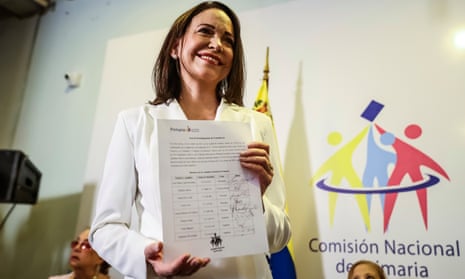
    Maria Corina Machado receives a document proclaiming her as the winner of the internal opposition elections, in Caracas, Venezuela, last week.
    Maria Corina Machado receives a document proclaiming her as the winner of the internal opposition elections, in Caracas, Venezuela, last week. Photograph: Miguel Gutiérrez/EPA

    Venezuela’s supreme court has suspended the results of the political opposition’s primaries after María Corina Machado was overwhelmingly elected last Sunday to take on President Nicolás Maduro in a presidential contest expected for 2024.

    The court – which is stacked with Maduro’s allies – also ratified bans on running for office which had been slapped on Machado and two others.

    Monday’s ruling was the latest effort to cast doubt on Machado’s eligibility and will probably provoke a reaction from the US, which lifted sanctions on Venezuela earlier this month in exchange for the government pledging to hold fair elections overseen by European observers.

    It came after Venezuela’s attorney general announced last week that the primaries, which were held independently without the involvement of the government, were under investigation for financial crimes and conspiracy.

    Machado won more than 90% of the vote with a higher than expected voter turnout and analysts predict she would probably beat Maduro in a fair contest.

    By deeming the selection of Machado fraudulent the Chavista government can cast further doubt on the former lawmaker’s eligibility to run while arguing that the issue of her ban is irrelevant, says Phil Gunson, senior analyst for the Andes region at Crisis Group.

    “There’s really no law or legal basis for this at all,” Gunson said.

    Opposition leaders have rejected the allegations against the primary process and say they will stand by the selection of Machado as the opposition candidate.

    “I reiterate my support for [the primaries] and the technical teams that accompanied it,” tweeted Delsa Solorzano, a member of Venezuela’s national assembly. “Venezuela expressed itself and nothing can change the will of a nation that wants change.”

    Corruption and economic mismanagement compounded by oil sanctions have forced more than 7 million people to flee Venezuela’s rampant food shortages, hyperinflation and rolling blackouts in the past decade.

    Maduro has retained control of the country despite its collapse by rigging elections, bribing military cadres and intimidating the political opposition with human rights violations.

    The supreme court ruling could further divide the opposition between those who want to participate in 2024’s electoral contest and those who want to boycott it, Gunson said.

    “It’s also a way to make the electorate feel that the contest is hopeless and that voting is a waste of time,” he added.

    The supreme court has ordered that the opposition turn in every piece of documentation related to the elections including candidate registration and all voter records within three days, so that an electoral commission can investigate the allegations.

    The opposition has raised concerns that the documents could be used to persecute the opposition and jeopardise next year’s elections.

    “This is a clear violation of the agreement the government signed with the opposition in Barbados and an outright escalation of the political crisis,” said Geoff Ramsey, senior fellow at the Atlantic Council. “Maduro’s acting like he doesn’t care about the prospect that the US could snap back the sanctions.”

    … there is a good reason people choose not to support the Guardian.

    Not everyone can afford to pay for news right now. That is why we choose to keep our journalism open for everyone to read. If this is you, please continue to read for free as you join us today from Germany.

    But if you can, then here are three good reasons to make the choice to support us today.

    1. We are fiercely independent and set our own agenda, an increasing rarity in a Europe of captured, compromised media.

    2. Our fearless, investigative journalism is a scrutinising force at a time when the rich and powerful are getting away with more and more, in Europe and beyond.

    3. Since Brexit, we have become more, not less, European and have now launched a new Europe edition. We've hired a spree of new correspondents on the continent, publish thousands of articles a year on European affairs, and are funded by around 180,000 supporters living in Europe – from the Atlantic to the Black Sea, the Arctic to the Mediterranean, including many in Germany.

    Choose to power the Guardian’s journalism for years to come, whether with a small sum or a larger one. If you can, please support us on a monthly basis from just €2. It takes less than a minute to set up, and you can rest assured that you’re making a big impact every single month in support of open, independent journalism. Thank you.

    senegal

      Markets IMF Draws Packed Senegal Session as New Program Talks Drag By  Vinicius Andrade  and  Jorgelina Do Rosario April 20, 2026 at 5:01 ...