Montag, 3. Mai 2021

Among the funds named in the complaints are Amundi Asset Management, Beauregard Holdings LLP, Greylock Global Opportunity Master Fund, and GoldenTree Asset Management. The latter had been in talks with the province over the weekend, and rejected an amended debt proposal from province officials after negotiations stalled.

 Markets

Buenos Aires Province Sued in U.S. for Missed Debt Payments

 Updated on 
  •  
    Creditors’ plan comes after failed debt talks with officials
  •  
    Province’s deadline for debt offer has been extended 13 times

Holders of bonds from Argentina’s largest province have filed lawsuits in New York for more than $366 million in unpaid principal and interest.

The Steering Committee of the Ad Hoc group of province bondholders submitted two legal claims against the province of Buenos Aires in the U.S District Court for the Southern District of New York after negotiations to restructure $7.1 billion in overseas debt stalled, according to complaints filed Tuesday.

The plan comes after a lack of progress in restructuring talks between the province and investors, more than six months after the federal government struck a deal to restructure $65 billion in sovereign bonds. The province published details of a new proposal shown to one of its largest creditors, GoldenTree Asset Management, on Monday, but the fund rejected the terms and the province didn’t accept a counteroffer that followed.

“Since April, the Province has made virtually no effort to engage in good faith negotiations with the Group to find a mutually agreeable and consensual solution, despite several attempts at engagement by the Group and its advisers,” according to a press statement. “Actions speak louder than words, and it is regrettable that the Provincial leadership has chosen to follow a course of confrontation and default.”

According to the two complaints, the creditors are demanding unpaid interest for $133 million and unpaid principal for $233 million. The complaints were filed separately to mark that the outstanding bonds were issued under two different legal indentures.

The press office for the province of Buenos Aires’ economy ministry didn’t reply to a request for comment. Buenos Aires has extended the deadline for creditors to accept its proposals more than a dozen times since its first offer appeared in April.
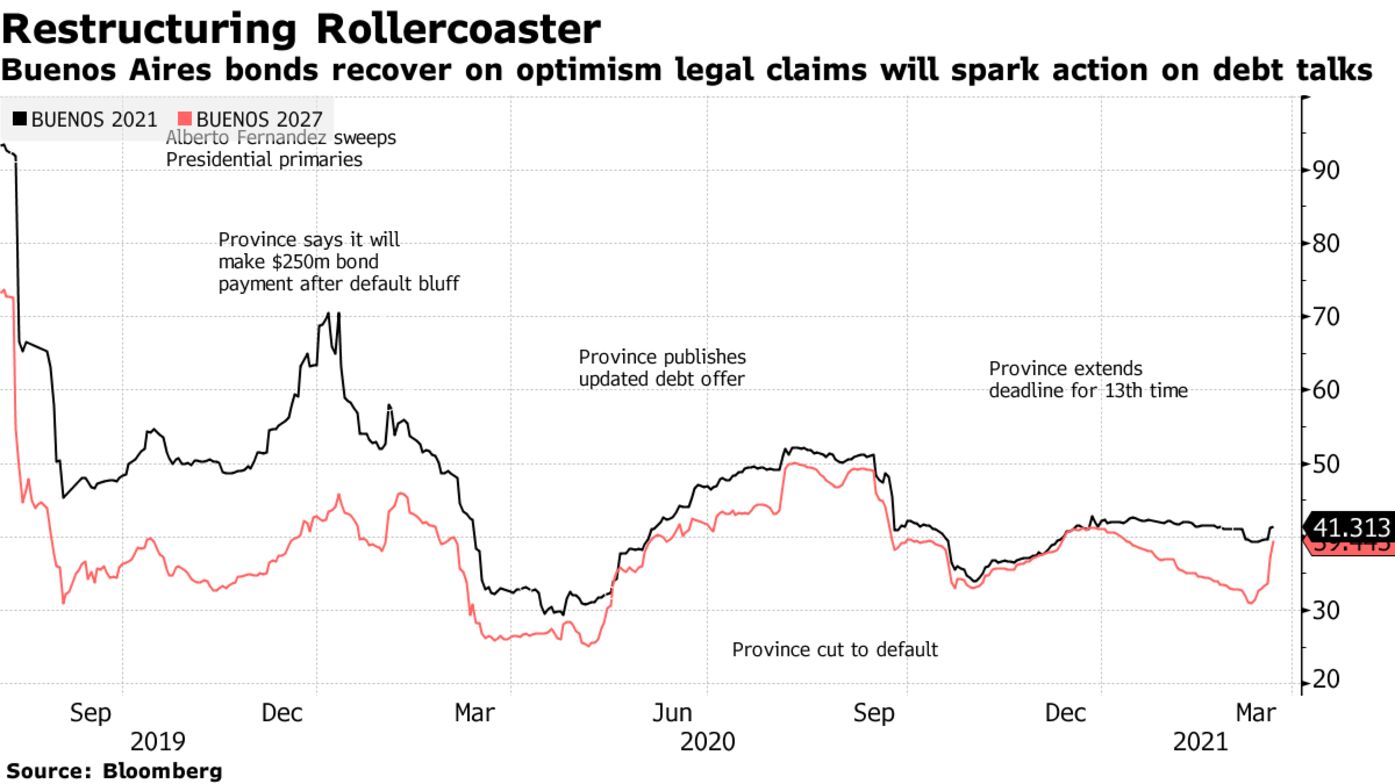
Buenos Aires bonds recover on optimism legal claims will spark action on debt talks

The province’s $1.75 billion in bonds due 2027 rose 1.2 cents to 38 cents on the dollar, their highest since Jan. 19.

A half-dozen other provinces, from Salta in the north to Neuquen in the south, have sealed restructuring deals over the past year amid an economic and currency crisis exacerbated by the pandemic.

Among the funds named in the complaints are Amundi Asset Management, Beauregard Holdings LLP, Greylock Global Opportunity Master Fund, and GoldenTree Asset Management. The latter had been in talks with the province over the weekend, and rejected an amended debt proposal from province officials after negotiations stalled.

READ MORE: Debt Restructuring Talks Stall for Argentina’s Biggest Province

“Whether this new suit actually strikes fear into the PBA team or not will depend on the parallel negotiation around GoldenTree’s counterproposal,” said Walter Stoepplewerth, chief investment officer at Portfolio Personal Inversiones in Buenos Aires.

A Long Road

Home to about 40% of the nation’s population, the province kicked off its debt restructuring process in Jan. 2020 when Governor Axel Kicillof first said he would delay a $250 million capital payment. He ended up transferring the money anyway.

Months later, the province proposed a fresh restructuring offer that was again rejected by creditors, and rating companies cut the province to selective default after it missed a payment in May.

“The members of the Group who have today filed claims remain open to considering proposals from the Province that fairly reflect the reality of the Province’s financial and economic position,” according to the statement. “In the meantime, they intend to vigorously pursue the legal proceedings that they have initiated today, and reserve in full their right to exercise additional available remedies at any time.”

This is not the first legal claim against an Argentine province. In January, Entre Rios province was sued for a missed interest payment in New York court, but bondholders said they would drop the legal claim after reaching a deal.

— With assistance by Patrick Gillespie, Bob Van Voris, and Chris Dolmetsch

(Updates with detail from both complaints, adds bond move in seventh paragraph, analyst quote in tenth paragraph

ratet mal wer das ist

 ich habe in der Zwischenzeit mit meinem Kollegen in NY nochmal Kontakt aufgenommen betreffend einer Klage gegen Venezuela.

Er ist gerade dabei eine Klägergruppe zu formieren.
Folgende Konditionen hat er mir genannt:


Depending on amount of holdings, we are looking at contingency fees of 15-20%, with zero start-up or other going-in fees or costs.


Das bedeutet, im Erfolgsfall eine Beteiligung von 15-20% des erstrittenen Geldes , keine weiteren Kosten oder Vorschüsse (start up fee).


Hätten Sie unter diesen Bedingungen Interesse an einer Klage ?


Mit besten kollegialen Grüßen

Samstag, 1. Mai 2021

Their release seen as Maduro’s gesture to Biden administration Maduro, his economy reeling, is seeking foreign investment


Politics

Six Citgo Executives Held in Venezuela Released to House Arrest

  •  
    Their release seen as Maduro’s gesture to Biden administration
  •  
    Maduro, his economy reeling, is seeking foreign investment

Six senior executives of Citgo Petroleum Corp. who have been detained by the Venezuelan government since 2017 were transferred from prison to house arrest, according to a person familiar with the matter.

The person, who was granted anonymity to discuss a sensitive diplomatic issue, said Friday night that the Biden administration considered the release a gesture of good will by the government of President Nicolas Maduro, which is seeking better relations with the U.S.

The person added, however, that American officials don’t believe that the release, which was reported earlier by the Associated Press, is a prelude to allowing the men to leave Venezuela.

The executives, including Jose Pereira, then the company’s acting president, were arrested in Caracas in November 2017. They had been summoned to a meeting at the headquarters of Petroleos de Venezuela SA, Citgo’s parent company.

The latest in global politics
Get insight from reporters around the world in the Balance of Power newsletter.
By submitting my information, I agree to the Privacy Policy and Terms of Service.

Pereira, who has permanent U.S. residency, along with American citizens Tomeu Vadell, Jose Luis Zambrano, Alirio Zambrano, Jorge Toledo and Gustavo Cardenas were later convicted on corruption charges. They deny the accusations and have appealed their convictions. Then Vice President Mike Pence said in 2019 that they were being held illegally and “this regime should release all political prisoners.”

Read More: At a Hotel in Caracas, Oil Executives Weigh Return to Venezuela

“The appeal request in a higher court has been left unanswered since we introduced it in December,” Diego Barboza, a lawyer for Toledo and Cardenas, said on Friday night. “The basis for the house arrest decision today is unknown as filings in courts show nothing new.”

Officials at Venezuela’s Information Ministry and the Prosecutor’s Office as well as the U.S. State Department didn’t reply to requests for comment made on Friday night.

Nearly 2 million Venezuelans have moved to Colombia in recent years to escape hunger and chaos, and Maduro has made overtures to foreign investors as he attempts to revive his country’s shattered economy.

The U.S. government continues to officially recognize opposition leader Juan Guaido as the country’s interim president until there’s a free and fair election. Biden has referred to Maduro as a dictator and his administration has given no indication that it would let up on sanctions imposed under President Donald Trump.

— With assistance by Nicolle Yapur, and Fabiola Zerp

unter einer schweren politischen Krise und unter Sanktionen vor allem der USA, die sich im venezolanischen Machtkampf auf Seiten der Opposition gestellt hat und die Regierung von Präsident Nicolás Maduro nicht anerkennt.

 WIRTSCHAFT

Hyperinflation außer KontrolleVenezuela vervielfacht Mindestlohn - auf zwei Euro im Monat

AP_21075675897193.jpg

Nagelneu und schon fast wertlos: Der neue 500.000-Bolívares-Schein.

(Foto: AP)

Venezuela steckt in der tiefsten Krise seiner modernen Geschichte. Millionen Menschen haben bereits das Land verlassen. Viele der Zurückgebliebenen können sich von ihrer Arbeit nicht ernähren. Die Regierung verkündet eine drastische Anhebung des Mindestlohnes. Doch die Preise steigen schneller.

Wegen der dramatischen Inflation hat Venezuela den Mindestlohn fast verdreifacht. Arbeitsminister Eduardo Piñate verkündete die Erhöhung vor Regierungsanhängern bei einer Kundgebung zum 1. Mai in der Hauptstadt Caracas. Mit dem Geld lässt sich allerdings angesichts der schlechten wirtschaftlichen Lage in dem südamerikanischen Land nicht einmal ein Kilo Fleisch kaufen.

Der neue monatliche Mindestlohn beträgt nun sieben Millionen Bolívares - umgerechnet fast 2,10 Euro. Dazu steht jedem Arbeitnehmer ein "Lebensmittelbonus" von einer Million Bolívares zu. Ein Kilo Fleisch kostet in Venezuela etwa 3,12 Euro. Die Regierung hatte den Mindestlohn zuletzt mehrmals jährlich angehoben. Mit den Preisen konnten diese Einkommenssteigerungen jedoch nicht Schritt halten.

Venezuela befindet sich in der schlimmsten Wirtschaftskrise seiner modernen Geschichte. Der einst reiche Ölproduzent durchlebt das vierte Jahr in Folge eine Hyperinflation. Der Internationale Währungsfonds erwartet für das laufende Jahr eine Steigerung der Verbraucherpreise um mehr als 5000 Prozent. Die Wirtschaftsleistung dürfte um zehn Prozent schrumpfen.

Venezuela leidet nicht nur unter der Corona-Pandemie, sondern schon seit Jahren unter einer schweren politischen Krise und unter Sanktionen vor allem der USA, die sich im venezolanischen Machtkampf auf Seiten der Opposition gestellt hat und die Regierung von Präsident Nicolás Maduro nicht anerkennt. Angesichts der lähmenden wirtschaftlichen und humanitären Krise sind laut UN-Angaben seit 2015 rund 5,4 Millionen Menschen aus dem Land geflohen.

Quelle: ntv.de, mbo/AF

Das Goldverbot für US-Bürger bestand für 41 Jahre und wurde am 31. Dezember 1974 durch Präsident Gerald Ford aufgehoben

 Das Goldverbot in den USA

Am 6. März 1933 verbot der US-amerikanische Präsident Franklin D. Roosevelt den Banken während der Bankfeiertage die Auszahlung von Gold und den Handel mit Devisen. Bereits 3 Tage danach wurde durch den "Emergency Banking Act" dem Präsidenten erlaubt, Einfluss auf den Gold- und Devisenhandel zu nehmen. So sollte der Abzug von Gold aus den USA verhindert werden. Sodann unterzeichnete Roosevelt am 5. April 1933 die Executive Order 6102. Hiermit wurde der private Goldbesitz in den USA ab dem 01. Mai 1933 verboten. Das Goldverbot trat in Kraft.

Der genaue Wortlaut des Gesetzes, vom ersten Entwurf bis zur bindenden Version, kann hier eingesehen werden: Gesetzestext des Goldbesitzverbotes in den USA.

Hintergrund dieses Verbots bildete die Weltwirtschaftskrise, welche am 24. Oktober 1929 mit dem schwarzen Donnerstag begann und massive Auswirkungen wie Deflation und Zusammenbrüche von Banken mit sich brachte. Gold gewann immer mehr an Wert. Viele US-Bürger horteten nun ihre Goldreserven zu hause oder schafften diese ins Ausland. Dem sollte entgegengewirkt werden durch das Goldverbot.

Die Konfiszierung des Goldes auf Grund des Goldverbotes wurde am 5. April 1933 rechtskräftig und betraf sämtliche Goldmünzen, Goldbarren und Goldzertifikate. Alles musste bis zum 1. Mai 1933 bei staatlichen Annahmestellen abgegeben werden zum Festpreis von 20,67 USD pro Feinunze. Lediglich Schmuck, Gold für industrielle Zwecke, Kunst oder Handwerk und Goldmünzen bis zu einem Wert von maximal 100 USD durften die Bürger behalten. Außerdem wurde auch das private Sammeln von historischen Goldmünzen weiter gestattet. Das Verbot war zudem nur auf das Inland beschränkt, Goldbesitz im Ausland war zunächst nicht betroffen.

Im Gegensatz zur freiwilligen Abgabe, bei der die US-Bürger die besagte minimale Zwangsentschädigung erhielten, wurde das Gold, das bei staatlich angeordneten Durchsuchungen gefunden wurde, entschädigungslos konfisziert. Die USA schreckten bei der Suche nach Gold auch nicht vor der gewaltsamen Öffnung von privaten Bankschließfächern zurück, die systematisch durchsucht wurden.

Bei Zuwiderhandlungen konnten Haftstrafen von bis zu 10 Jahren und/oder bis zu 10.000 USD Strafe verhängt werden.

Im Jahr 1961 dehnte der damalige US-Präsident Dwight D. Eisenhower das Goldverbot noch einmal aus. Der Goldabfluss aus den USA sollte gänzlich gestoppt werden und so wurde das Goldverbot, welches sich bisher auf den privaten Besitz von Gold im Inland beschränkt hat, auch auf den privaten Besitz von US-Bürgern im Ausland augeweitetet. Sämtliche US-Bürger und auch Unternehmen durften kein Gold oder gegen Gold einlösbare Wertpapiere in ausländischen Depots halten und es war auch verboten, sich überhaupt am Goldhandel zu beteiligen. Auch in diesem Fall drohten empfindliche Strafen bei Zuwiderhandlungen. Ausgenommen waren wiederum seltene Goldmünzen.

In den folgenden Jahren stieg daraufhin die Einfuhr von vor 1933 geprägten Goldmünzen rapide an. Deren Besitz war ja nach wie vor erlaubt. 1962 verbot Präsident John F. Kennedy nun auch den inländischen Besitz von Goldmünzen, welche vor 1933 peprägt wurden und aus dem Ausland importiert wurden. Ein Besitz dieser Goldmünzen sowie ein Import in die USA waren nun strikt verboten. Alle im Ausland befindlichen Münzen von US-Bürgern mussten ins Inland zurückgebracht werden. Die Regierung wollte so angeblich den zunehmenden Fälschungen und Nachprägungen entgegenwirken.

Dies hatte jedoch zur Folge, dass die Preise für Goldmünzen in den USA massiv anstiegen. Außerdem kam es nun zu einem enormen Anstieg der Schmugglertätigkeiten.

Das Goldverbot für US-Bürger bestand für 41 Jahre und wurde am 31. Dezember 1974 durch Präsident Gerald Ford aufgehoben

senegal

  Markets IMF Draws Packed Senegal Session as New Program Talks Drag By  Vinicius Andrade  and  Jorgelina Do Rosario April 20, 2026 at 5:01 ...