Lebanon has resumed talks with the International Monetary Fund and is committed to seeking a “fair and comprehensive” solution for its creditors, the finance ministry said on Monday.
Lebanon began bailout talks with the IMF after defaulting on its international bonds in 2020 and drafted a plan to restructure its entire $90 billion debt stock. But there’s been scant progress in the past 18 months due to a prolonged political deadlock.
Lebanon “remains fully committed to engage in a constructive, transparent and equitable debt restructuring process with all other stakeholders” the finance ministry statement said.
International investors hold a substantial chunk of Lebanon’s Eurobonds and a deal with them is essential if the government is to eventually return to the debt market
Bonds are among world’s worst performers since primary vote
Fernandez seems recommitted to spending after election loss
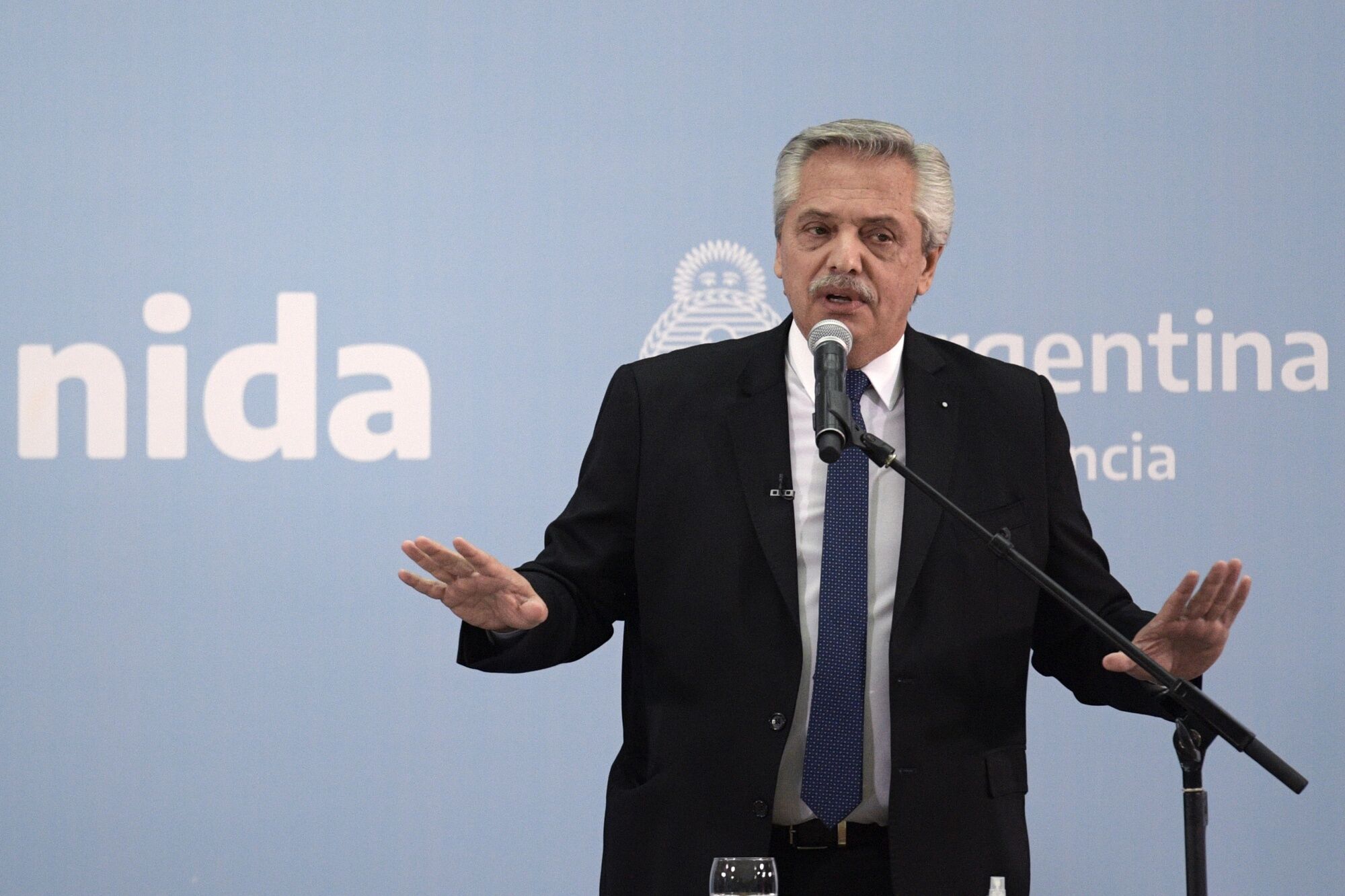
President of Argentina Alberto Fernandez speaks during the Ministers' swearing in ceremony at Museo del Bicentenario on September 20, 2021 in Buenos Aires, Argentina.Photographer: Pool/Getty Images South America
Argentina’s primary election went just the way investors wanted, delivering a stinging rebuke to President Alberto Fernandez and leftist policies that have upended the economy.
It was exactly what traders who had bid up sovereign notes to a nine-month high before the vote were envisioning -- a drubbing so severe that certainly it would lead Fernandez to finally put aside the failed policies of Argentina’s radicals and turn toward economic orthodoxy for the last two years of his administration.
Instead, he seems to be going in the opposite direction.
Soon after the loss two weeks ago, Fernandez remade his cabinet by replacing some of the more moderate members. He promised to ramp up social spending ahead of the November vote that will decide control of both houses of Congress. And he has sped up money printing to pay for it all, a move that risks worsening inflation already running at 50%.
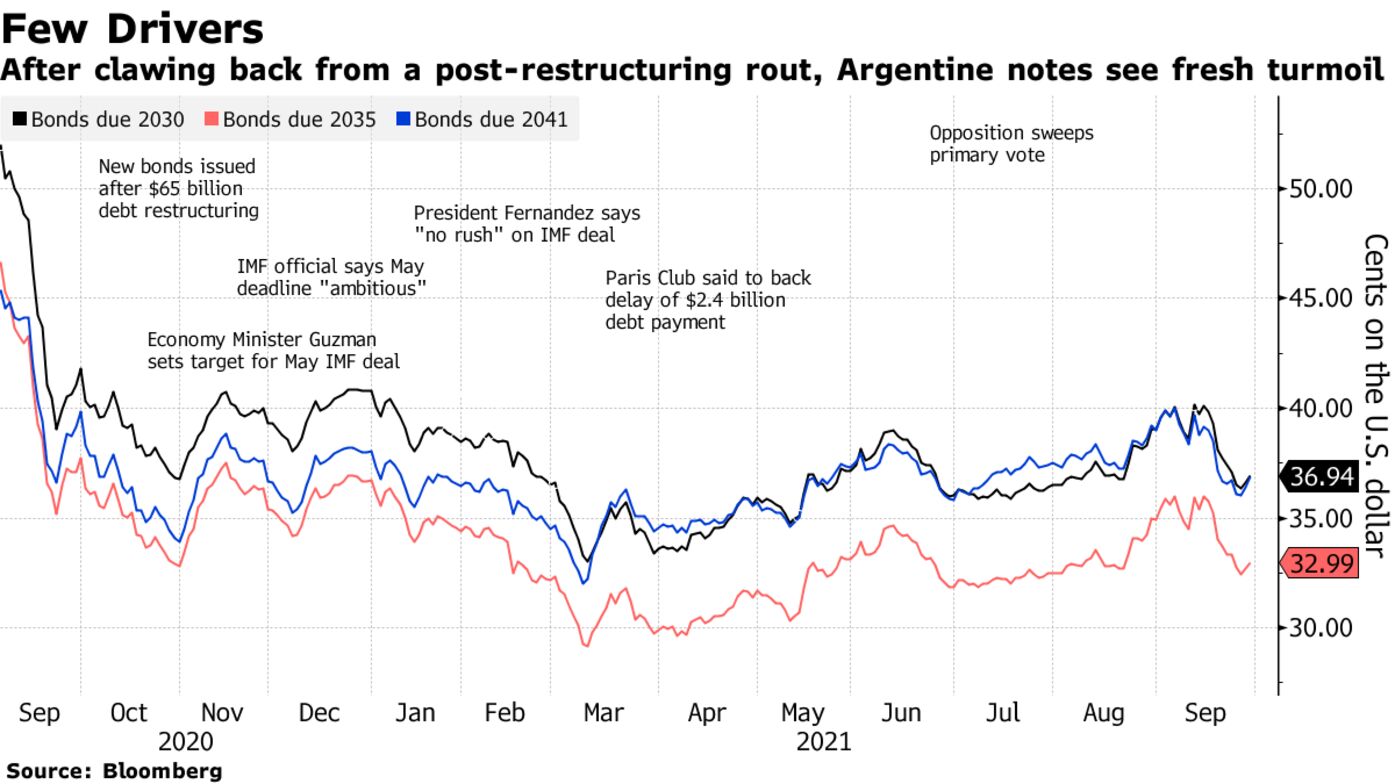
Bonds have taken a nose dive as Fernandez goes all in on economic populism, posting one of the world’s worst performances since the vote and handing investors losses of more than 3%. Prices recently tumbled to about 30-some cents on the dollar, their lowest since July, over concern the surge in spending will further damage Argentina’s already precarious finances, undermine the currency and eventually lead to another multi-billion-dollar default, the country’s fourth this century.
Further adding to market pessimism is the lack of events on the horizon that could provide some relief before general elections in 2023. A deal to rework Argentina’s $45 billion credit with the International Monetary Fund would have once been a positive development. But negotiations will be complicated by Fernandez’s insistence on populist spending, which will empty Argentina’s already dangerously low liquid reserves by year-end, according to Mauro Roca, managing director of emerging markets at TCW Group Inc. in Los Angeles.
“Alberto Fernandez’s administration is practically betting the house on the midterm elections,” said Roca, who oversees $17 billion in emerging-market assets. “There’s going to be payback for those policies in the form of inflation, and the IMF talks will be taking place under even worse conditions than we’re seeing now.”
Investors have grown disillusioned by the eternal promise of moderation from Fernandez’s government, futilely waiting for an unwinding of capital controls, the lifting of export restrictions and an end to the price fixing Argentina has used to manage the economy. Hopes were further dashed by post-election comments from Vice President Cristina Fernandez de Kirchner in which she blamed the president’s economic strategy for a “political catastrophe.” Now more than ever, Fernandez’s fractured ruling coalition is unlikely to agree on methods to return the country to growth, according to Diego Ferro, founder of M2M Capital in New York.
“You’re not going to see coherent economic policies out of a government run by groups of people who have very different views on the direction and identity of the country,” Ferro said. “In two years, it’s hard to know what kind of Argentina the next government is going to inherit.”
Fernandez’s allies suffered at the polls amid political scandals over flaunting quarantine rules and early access to coronavirus vaccines, as well as a perceived mismanagement of the pandemic response. The opposition Juntos por el Cambio coalition took most of the country’s districts, including an unexpected victory in the Province of Buenos Aires, which accounts for more than a third of the total electorate.
Alberto Fernandez, Argentina’s president, speaks to members of the media after casting a ballot at a polling station during the primary elections in Buenos Aires, Argentina, on Sunday, Sept. 12, 2021.
That’s not to say it’s all bad news for Argentines. With almost half the population fully vaccinated against Covid-19 and a relaxation of pandemic restrictions ahead of the summer tourist season, the economy is expected to rebound almost 7% this year, according to forecasts compiled by Bloomberg. Gross domestic product contracted 10% last year as the nation suffered through one of the world’s most prolonged lockdowns.
The best bet for investors in Argentina may be shifting into recently restructured bonds from the Province of Buenos Aires, which carry higher coupons than Argentina’s notes, according to Siobhan Morden, the head of Latin America fixed income at Amherst Pierpont in New York.
Buenos Aires-based brokerage Portfolio Personal Inversiones suggests taking a defensive posture, ditching Argentina’s most recently issued bonds for older securities that sport slightly higher coupons and stronger legal protections for investors.
Walter Stoeppelwerth, a fund manager at Gletir Corredor de Bolsa, said Argentina’s fiscal situation makes it inevitable that a reckoning lies ahead.
“The numbers don’t lie,” he said in a webinar hosted by Portfolio Personal Inversiones on Thursday. “The biggest risk to being a bondholder in Argentina is that the government runs out of dollars again.”
162 Für Zwecke des Kapitalertragsteuerabzugs gilt die Übertragung eines von einer auszahlenden Stelle verwahrten oder verwalteten Wirtschaftsguts i. S. von § 20 Absatz 2 EStG auf einen anderen Gläubiger grundsätzlich als Veräußerung des Wirtschaftsguts.
163 Eine nach § 43 Absatz 1 Satz 4 EStG fingierte Veräußerung ist nur dann kapitalertragsteuerpflichtig, wenn sich nach der Übergangsregelung in § 52 Absatz 28 EStG eine materielle Steuerpflicht des Veräußerungsgewinns nach § 20 Absatz 2 EStG ergeben würde.
Beispiel:
A überträgt an B Aktien, die er im Jahr 2006 erworben hat.
164 Die auszahlende Stelle muss die anfallende Kapitalertragsteuer vom Kunden einfordern bzw. das Betriebsstättenfinanzamt informieren, soweit der Betrag nicht zur Verfügung gestellt wird (entsprechende Anwendung von § 44 Absatz 1 Satz 7 bis 11EStG).
OFD Frankfurt/M. - S 2252 A - 104 - St 219
Einzelfragen zur Abgeltungsteuer
geänderte Fassung durch
Bezug: BStBl 2016 I, 85 BStBl 2016 I, 475 BStBl 2016 I, 527 BStBl 2017 I, 739 BStBl 2018 I, 52 BStBl 2018 I, 624 BStBl 2018 I, 85
d) Depotübertrag mit Gläubigerwechsel (§ 43 Absatz 1 Satz 4 bis 6 EStG)
Veräußerungsfiktion bei Depotübertrag mit Gläubigerwechsel (§ 43 Absatz 1 Satz 4 EStG)
162
Für Zwecke des Kapitalertragsteuerabzugs gilt die Übertragung eines von einer auszahlenden Stelle verwahrten oder verwalteten Wirtschaftsguts i. S. von § 20 Absatz 2 EStG auf einen anderen Gläubiger grundsätzlich als Veräußerung des Wirtschaftsguts.